Why get braces?
One of the most common reasons why most of our patients undergo orthodontic treatment is for aesthetics reasons. Some people are very aware of how they teeth appear to others. A beautiful, straight smile increases a person’s confidence and self esteem. Not only that, orthodontic treatment also aims to correct the “bite” of the patient, which improves the appearance and the side profile of the patient.
However, there are also other benefits involved in having braces, such as the fact that it makes cleaning teeth easier. Teeth that overlap with one another, or crowd in the mouth, can be quite difficult to clean as it is hard to reach into all areas. This might then lead on to further problems with gum decay and tooth cavities. Having well aligned teeth will make it easier to clean the teeth.
Correction of the bite, or occlusion, may also lead to better chewing, which aids food digestion. Aligned teeth may also help with speech problems, as some people have speech problems associated with the alignment of their teeth or jaws. Crooked or unaligned teeth may also show some abnormal, or damaging patterns of wear. Some gum damage has also been linked to incorrect bite problems, such as where the lower front teeth injures the gum of the upper front teeth in a case of a malocclusion (“bad bite”).

What are braces?
Reminders about braces + care during treatment
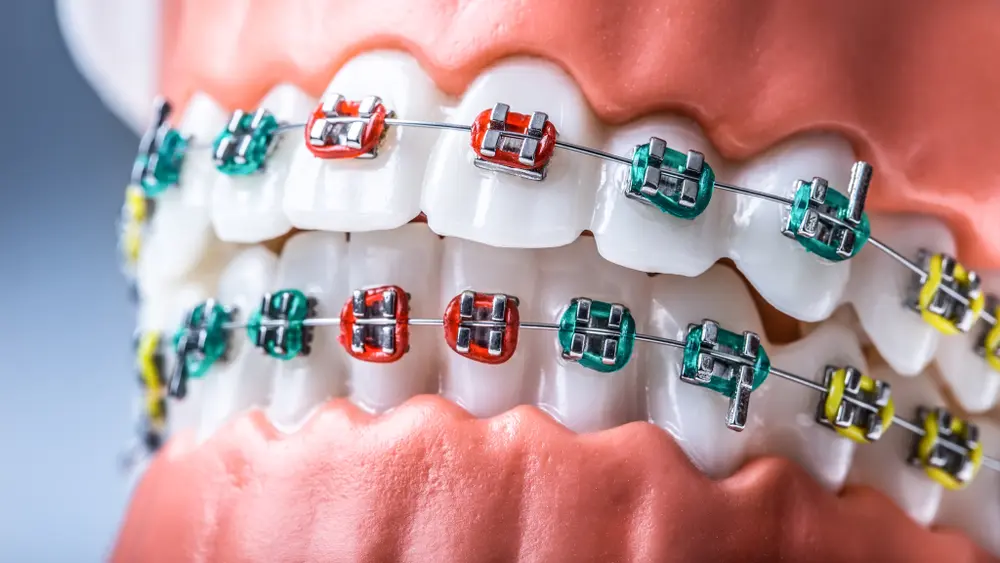
It is extremely important that the teeth are kept clean throughout the entirety of the treatment. Yes, braces make cleaning the teeth more difficult. However, the task is not impossible. Dental decay during treatment is problematic and may cause an extension in treatment time. It is important to note here that braces themselves do not cause decay; it is the lack of effort involved in brushing the teeth which causes decay. Food and plaque may collect on the brackets which are glued on the teeth. If these are not removed, white marks on the surfaces of the teeth may result. These white marks are known as decalcification. They are not only unsightly, but are also the first sign of decay. Make sure to go back to your local or family dentist for six monthly check up appointments during orthodontic treatment, so that they may monitor the condition of the teeth and keep an eye on any possible cavities that may form.
Another important thing to remember is to try to prevent damage to the braces whenever possible. The metal brackets are bonded on to the teeth by glue. This glue may be weakened (especially on the brackets in the front teeth) when consuming hard, crunchy or sticky foods. Foods in this category include things like sticky lollies, carrot sticks, hard potato or corn chips, chewing gum or fruits like apples. Avoid eating these whenever possible, or, in the case of hard foods like apples or steak, cut the food up into small pieces before eating. The weakening of the bond between the brackets and the teeth may be gradual, such that it may not break immediately upon consuming these foods, but may become weaker until they are eventually dislodged by some other soft foods. When the brackets come off or come loose, the patient is then required to come in for another visit and glue the brackets back on, which is a time consuming process.
Remember to come to your six weekly appointments. These are very important for adjusting the braces and making sure the treatment is on track and coming along effectively. Generally, the time frame for these appointments range from 6-8 weeks. For your convenience, a text reminder of the appointment will be sent to your mobile phone, so please make sure that all your details with us are kept up to date.